

Of course, these benefits are most pronounced in the context of an overall healthy diet. No one food – even whole grains – will guarantee good health. It’s also important to remember that some whole grain foods are healthier than others. Plain grains — from brown rice and quinoa to wheat berries –– and whole grain pasta should be a regular feature on your table, with processed grains eaten less often. Sure a whole grain cookie is better for you than a refined grain one, all other ingredients being equal — but it’s still a cookie!
Check out the Oldways website for overall diet information and inspiration about the health benefits of traditional diets, including the Mediterranean Diet.
The main benefits of whole grains
The benefits of whole grains most documented by repeated studies include:
- reduced risk of stroke
- reduced risk of type 2 diabetes
- reduced risk of heart disease
- better weight maintenance
- less inflammation
- lower risk of colorectal cancer
2017 Summary of Recent Whole Grain Health Research
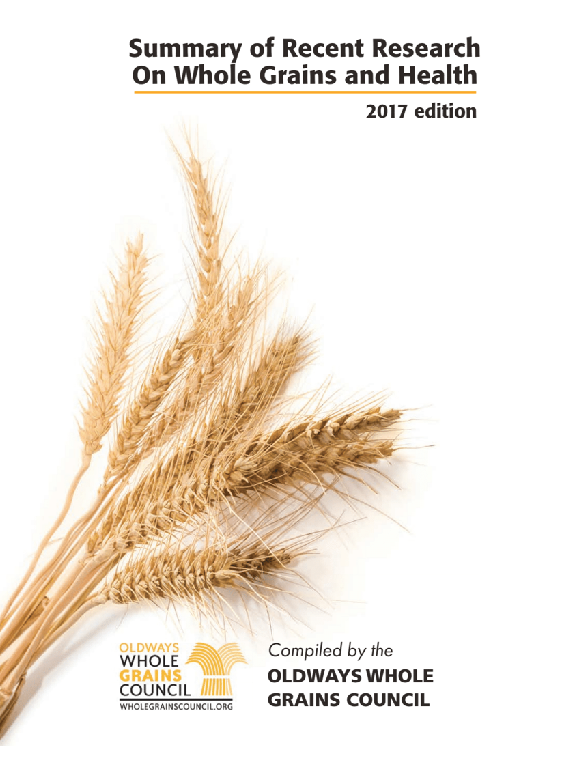
In 2009, the Oldways Whole Grains Council released a research summary of major studies analyzing the health benefits of whole grains and published from 2004 to 2008 (archived below). In the years since, more than 100 new studies on this topic have deepened our understanding of why whole grains support good health. In this new report, we’ve summarized 112 studies published between 2012 and 2017, to make this knowledge available to health professionals, policy makers, and anyone else who can benefit from this compilation.
Download the 2012-2017 Research Summary (1.7MB PDF)
2017 ICQC Scientific Consensus on Whole Grains
At the International Carbohydrate Quality Consortium (ICQC) meeting in September 2017, participants gathered in Rome to create a new consensus statement focused on the benefits of whole grains, since grains are the major source of carbohydrates globally. (See here for background on Oldways’ previous work with the ICQC.)
Download the 2017 ICQC Scientific Consensus on Whole Grains (PDF)
Archived Summaries of Whole Grain Health Research
2009 WCG Research Summary
To support the deliberations of the 2010 Dietary Guidelines Advisory Committee, Oldways and the Whole Grains Council have compiled a summary of research on whole grains and health that has been undertaken since the 2005 Dietary Guidelines. This PDF report includes information from almost four dozen studies, largely from 2006 to 2008; it augments an earlier compendium from the Bell Institute of Nutrition at General Mills.
Download the 2009 WGC Research Summary (2.8M PDF)
Link to the Bell Institute website, to download “Whole Grain and Health – Get the Whole Story.”
Putting the Whole Grain Puzzle Together:
Health Benefits Associated with Whole Grains
In April 2010, the American Society for Nutrition brought together researchers to review the evidence regarding the health benefits associated with whole grains. Current scientific evidence indicates that whole grains play an important role in lowering the risk of chronic diseases, such as coronary heart disease, diabetes, and cancer, and also contribute to body weight management and gastrointestinal health. The findings were published as a supplement to The Journal of Nutrition in May 2011 and made available as a Free Article.
Download the ASN 2010 evidence review (552K PDF)
Whole Grains and Human Health – an Overview
In 2004 (Nutrition Research Reviews, May 2004; Vol 17: 99-110), Dr. Joanne Slavin of the University of Minnesota published a comprehensive article that reviewed and compiled scores of recent studies on whole grains and health, to show how whole-grain intake is protective against cancer, cardiovascular disease, diabetes and obesity.
Download Slavin’s evidence review (454K PDF)
Thumbnails of Recent Health Studies
As new research appears linking whole grains to better health, we post short summaries of these studies on the Whole Grains Council website. Click here to see thumbnails of a wide variety of recent studies on whole grains and health.